
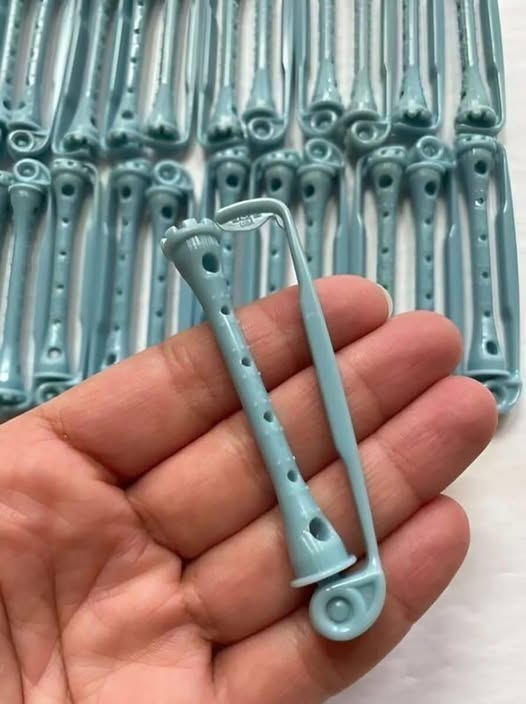
If you’ve ever come across a strange collection of colorful plastic cylinders in an old bathroom drawer, thrift store, or vintage beauty box, you might have wondered what they were used for.
Their unusual shapes can make them look like pieces of a toy, a miniature mechanical device, or even an unidentified household gadget.
But these colorful objects often have a much simpler explanation.
They are vintage plastic perm rods, once a familiar part of home hair care and professional beauty salons.
Today, these old-fashioned hair tools have become fascinating objects for collectors, nostalgia enthusiasts, and people discovering them for the first time.
What Are Vintage Perm Rods?
Perm rods are small cylindrical rollers used to shape hair during a permanent wave, commonly called a “perm.”
Unlike ordinary curlers, perm rods were specifically designed to work with chemical permanent-wave solutions.
The hair was wrapped around the rods, treated with a waving solution, and then processed so that the hair would take on a new curl or wave pattern.
The result could last for weeks or months, depending on the person’s hair and the type of treatment used.
Why Do They Come in So Many Colors?
If you’ve ever seen a vintage collection of perm rods, you may have noticed that they’re often brightly colored.
The colors weren’t necessarily just decorative.
Different rod sizes could produce different curl patterns. Manufacturers often used different colors to help distinguish between sizes.
Generally, smaller rods created tighter curls, while larger rods produced looser waves.
A stylist could therefore select different rod sizes depending on the desired hairstyle.
How Were They Used?
The process required patience and precision.
First, the hair was divided into sections.
Individual sections were wrapped around the rods, with the hair tension and direction carefully controlled.
The rods were secured in place, and the hair was treated with a chemical waving solution.
After processing, another solution was applied to help stabilize the newly formed shape.
The rods were then removed, revealing the new curl pattern.
Because the chemicals involved could irritate the skin or damage hair if used incorrectly, permanent waving was traditionally something people approached with considerable care.
Why Were Perms So Popular?
Permanent waves allowed people to change the texture and appearance of their hair without having to curl it every morning.
For many decades, curls and waves were highly fashionable.
Beauty salons regularly performed perms, and home-perm kits also became widely available.
For someone with naturally straight hair, a perm could create volume and curls that lasted much longer than temporary styling methods.
For people with naturally curly or wavy hair, permanent treatments could also be used to alter or control the shape.
The Evolution of the Perm Rod
Perm rods changed considerably over the years.
Earlier versions were often relatively simple, while later designs incorporated features intended to make wrapping and securing the hair easier.
Materials also evolved.
Plastic became particularly useful because it was lightweight, durable, inexpensive, and easy to clean.
The colorful plastic rods commonly associated with vintage beauty equipment were therefore practical as well as visually distinctive.
Why Do They Look So Strange Today?
Modern hair tools have changed dramatically.
Today, people are more familiar with:
- Heated curling irons
- Electric rollers
- Automatic curlers
- Ceramic styling tools
- Flexible foam rollers
- Heatless curling systems
As a result, someone who has never seen a traditional perm rod may have no idea what these little plastic cylinders are.
Without their original context, they can look completely mysterious.
That’s part of what makes vintage beauty tools so interesting.
Different Rod Sizes Created Different Results
One of the most important characteristics of a perm rod is its diameter.
The basic principle is straightforward:
Smaller diameter = tighter curl.
Larger diameter = looser wave.
A stylist could use several different sizes on the same head of hair to create a particular pattern.
The direction in which the hair was wrapped also affected the final appearance.
This meant that perming wasn’t simply a matter of attaching random rollers to the hair. It involved technique, planning, and experience.
What Are the Little Rubber Bands For?
Many traditional perm rods were used with small elastic bands.
After the hair was wrapped around the rod, the band helped hold the hair in place.
This simple design made the rods inexpensive and reusable.
Some rods also had grooves, ridges, holes, or other features that helped with securing the hair or distributing the chemical solution.
These small design details can vary significantly between manufacturers and generations of perm rods.
Vintage Beauty Tools as Collectibles
Old perm rods may seem insignificant, but they can be interesting examples of everyday design history.
Collectors may be interested in:
- Unusual colors
- Complete sets
- Vintage packaging
- Manufacturer markings
- Original salon equipment
- Advertising materials
- Unusual rod shapes
- Older home-perm kits
A complete original set with its packaging can be particularly interesting because it preserves not only the tool but also the way the product was marketed to consumers.
Don’t Assume Every Plastic Roller Is a Perm Rod
Not every vintage roller was designed for permanent waving.
Some plastic rollers were intended for temporary styling and were simply removed after the hair dried.
Others were designed to be heated or used with different styling techniques.
That’s why markings, packaging, shape, and accompanying accessories can be useful when identifying an unknown vintage hair tool.
Can Vintage Perm Rods Still Be Used?
Technically, old plastic rods may still be physically usable if they are clean and undamaged.
However, the chemical products used with permanent waving are a separate issue.
Old chemicals should never be assumed to be safe simply because the container looks intact. Modern products and instructions can also differ substantially from older formulations.
Anyone considering a chemical perm should follow the instructions for a current, appropriate product and consider professional advice, especially if the hair is chemically treated, damaged, or sensitive.
Why These Old Tools Are Going Viral
The internet has a habit of turning ordinary vintage objects into mysteries.
Someone finds a strange item while cleaning out a relative’s house.
They take a photograph.
They post it online.
And suddenly thousands of people are trying to identify it.
Vintage perm rods are perfect candidates for this phenomenon because they have an unusual appearance but were once extremely common.
To someone who grew up with them, they’re instantly recognizable.
To someone born decades later, they can look completely inexplicable.
A Small Piece of Beauty History
Vintage plastic perm rods represent more than an old-fashioned way of curling hair.
They offer a glimpse into how beauty routines, technology, manufacturing, and fashion have changed over time.
Before today’s sophisticated styling tools, people relied on relatively simple objects—and often considerable skill—to achieve elaborate hairstyles.
That little plastic cylinder sitting in an old drawer may have once been part of someone’s weekly beauty routine.
Final Thoughts
The next time you see a collection of colorful plastic rods and wonder what strange purpose they served, take a closer look.
They may not be mysterious mechanical components at all.
They could simply be vintage perm rods, everyday beauty tools that helped generations of people create curls and waves.
What looks like a bizarre piece of plastic today was once an essential tool in bathrooms and salons around the world.
And that’s what makes vintage objects so fascinating: ordinary things from yesterday can become mysteries to everyone who encounters them today.