
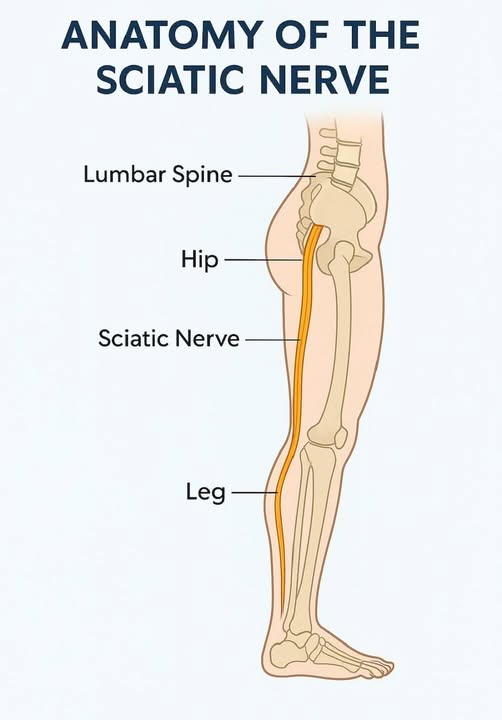
The sciatic nerve is one of the most important nerves in the human body. It is also the largest and longest single nerve, playing a major role in movement and sensation throughout the lower body. Because of its size and extensive pathway, problems involving the sciatic nerve can cause pain, numbness, tingling, or weakness that may extend from the lower back into the leg and foot.
Understanding the anatomy of the sciatic nerve can make it easier to understand why symptoms sometimes travel along such a large portion of the leg.
What Is the Sciatic Nerve?
The sciatic nerve is a large peripheral nerve that connects the lower spine with structures in the buttocks and legs. It is formed by several nerve roots originating in the lower lumbar and sacral regions of the spinal cord.
More precisely, the sciatic nerve is formed from nerve roots L4, L5, S1, S2, and S3. These roots come together in the pelvis and form the large sciatic nerve on each side of the body.
There is one sciatic nerve on the left and one on the right.
Where Does the Sciatic Nerve Begin?
The nerve roots that contribute to the sciatic nerve originate from the lower portion of the spinal cord through openings between the vertebrae.
These nerve roots combine to form a network called the lumbosacral plexus. From there, the sciatic nerve emerges through the pelvis and enters the buttock region.
The nerve usually passes beneath the piriformis muscle, a small muscle located deep in the buttock.
This anatomical relationship is important because irritation or compression around this area can sometimes affect the sciatic nerve.
The Path of the Sciatic Nerve
After leaving the pelvis, the sciatic nerve travels through the buttock and down the back of the thigh.
It is actually made up of two major nerve components that travel together for much of their course:
- Tibial nerve
- Common fibular (peroneal) nerve
Near the knee, these components generally separate.
The tibial nerve continues downward toward the back of the lower leg and foot, while the common fibular nerve travels around the outer portion of the knee before dividing into additional branches.
This extensive branching allows the nerve system to communicate with muscles and sensory structures throughout much of the lower limb.
What Does the Sciatic Nerve Do?
The sciatic nerve has both motor and sensory functions.
Motor Function
Through its branches, the sciatic nerve helps control several muscles responsible for movements of the hip, knee, ankle, and foot.
It contributes to movements such as:
- Bending the knee
- Moving the ankle
- Moving the toes
- Controlling parts of the foot
- Supporting movements of the hip and leg
Because several important muscles depend on branches of the sciatic nerve, significant nerve dysfunction can result in weakness.
Sensory Function
The sciatic nerve and its branches also carry sensory information from parts of the lower leg and foot.
Depending on the location of nerve involvement, a person may experience:
- Numbness
- Tingling
- Burning sensations
- Pins and needles
- Altered sensitivity
- Pain that travels down the leg
The exact area affected depends on which nerve roots or branches are involved.
Why Sciatic Nerve Pain Can Travel Down the Leg
One of the most recognizable features of sciatic nerve irritation is pain that extends from the lower back or buttock down the leg.
This happens because the nerve pathway is so extensive.
A problem affecting a nerve root in the lower spine can produce symptoms farther along the nerve’s distribution. For example, irritation of a lumbar nerve root may cause pain or altered sensation in the buttock, thigh, calf, or foot.
This is why symptoms don’t necessarily remain at the location where the problem originates.
Common Causes of Sciatic Nerve Problems
Sciatic-type symptoms can have several possible causes.
One of the most common is a herniated disk, in which material from an intervertebral disk can press against or irritate a nearby spinal nerve root.
Other possible causes include:
- Degenerative changes in the spine
- Narrowing of spaces around spinal nerves
- Bone spurs
- Certain spinal injuries
- Conditions affecting the muscles or tissues around the nerve
- Less commonly, tumors or other structural problems
Not every case of pain traveling down the leg is caused by direct compression of the sciatic nerve itself. Sometimes the problem originates from one of the nerve roots that eventually contributes to the sciatic nerve.
Sciatica vs. Sciatic Nerve Anatomy
The term sciatica generally describes symptoms caused by irritation or compression of the sciatic nerve or, more commonly, one of its contributing nerve roots.
Typical symptoms may include pain beginning in the lower back or buttock and extending into the leg.
Some people experience numbness or tingling, while others may develop weakness.
Importantly, ordinary lower-back pain is not automatically sciatica. Sciatica usually involves symptoms extending along a nerve distribution into the lower limb.
When Should You Seek Medical Attention?
Mild nerve-related discomfort can sometimes improve with appropriate conservative care, but certain symptoms require prompt medical evaluation.
Seek urgent medical attention if back or leg symptoms are accompanied by:
- New or worsening weakness in the leg
- Significant loss of sensation
- Loss of bladder or bowel control
- Numbness around the groin or inner thighs
- Severe symptoms following a significant injury
- Rapidly worsening neurological symptoms
These signs can indicate a more serious neurological problem that requires immediate assessment.
How Is Sciatic Nerve Pain Evaluated?
A healthcare professional may begin with a medical history and physical examination.
The examination can include checking:
- Muscle strength
- Reflexes
- Sensation
- Walking ability
- Range of motion
- Specific movements that reproduce symptoms
Imaging such as an MRI may sometimes be recommended when symptoms are severe, persistent, associated with neurological deficits, or when a specific structural problem needs to be investigated.