
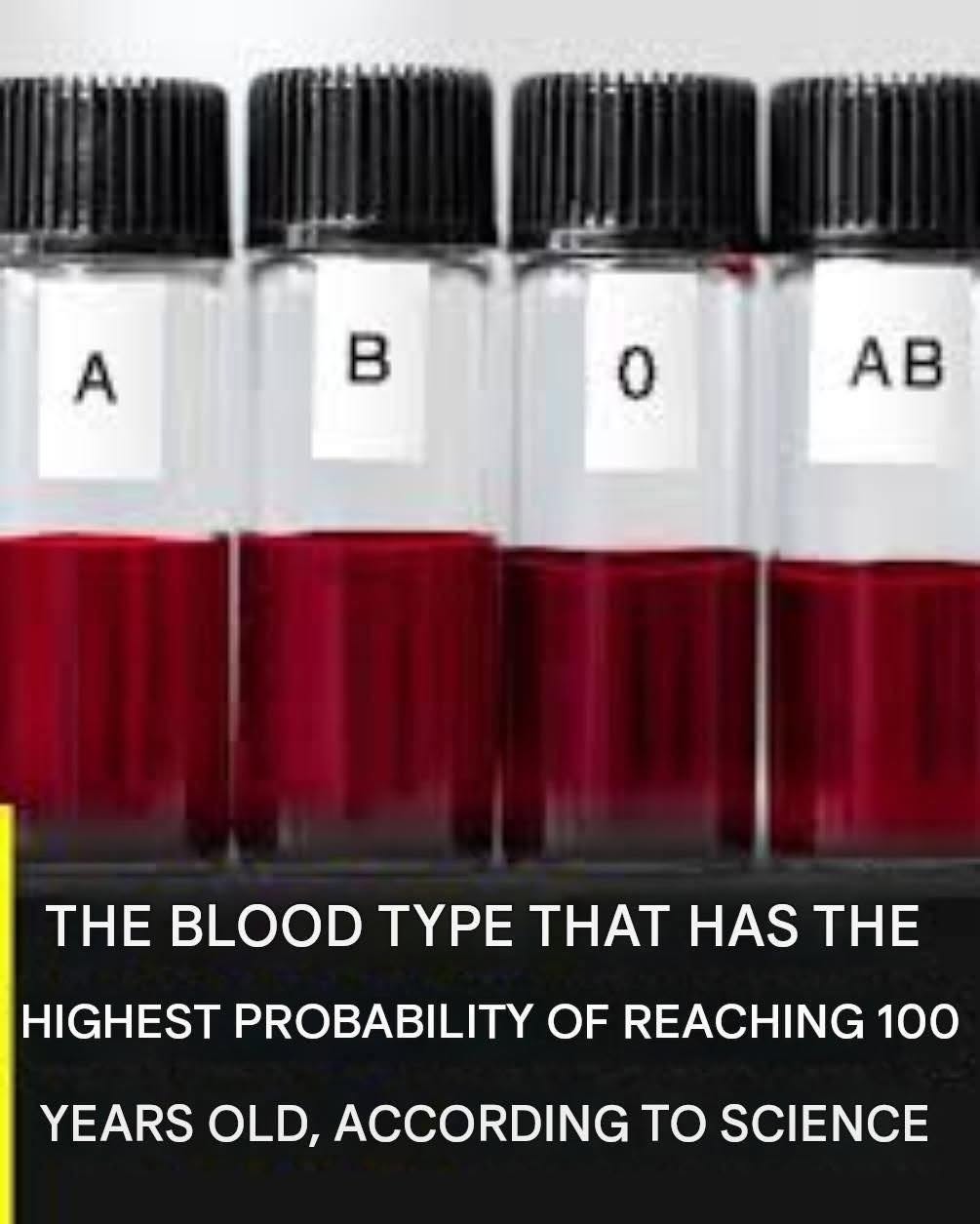
Have you ever wondered whether your blood type could influence how long you live?
A viral claim circulating online suggests that people with one particular blood type are more likely to reach the age of 100. The idea is intriguing because blood type is determined genetically and remains essentially unchanged throughout life.
But when scientists have actually studied the relationship between ABO blood type and longevity, the results have been mixed.
One older Japanese study found that blood type B was more common among people who had reached 100 than among younger controls. However, larger and later research has not consistently reproduced that finding. (PubMed)
So, is there really a “longevity blood type”?
The Four Main Blood Types
The ABO blood group system divides blood into four major types:
- A
- B
- AB
- O
These types are determined by specific antigens on the surface of red blood cells.
Blood type is important for blood transfusions, but researchers have also investigated whether it may be associated with susceptibility to certain diseases and, consequently, differences in lifespan.
The Study That Put Blood Type B in the Spotlight
A 2004 study published in Experimental Gerontology compared 269 people over 100 years old in Tokyo with more than 7,000 controls.
The researchers found that type B represented about 29.4% of the centenarians, compared with 21.9% of the controls.
Based on that study, the researchers suggested that blood type B might be associated with exceptional longevity. Importantly, they also stated that the mechanism behind the observation needed further investigation. (PubMed)
This is likely one reason the idea that a particular blood type is linked to living to 100 continues to circulate online.
But one study isn’t enough to establish that relationship.
Larger Research Tells a Different Story
A much larger study examined 2,201 Chinese centenarians and 2,330 middle-aged controls.
Researchers compared the frequencies of A, B, O, and AB blood types between the groups.
They found no statistically significant differences between centenarians and controls for the four blood types. The researchers concluded that their findings did not support an association between ABO blood groups and longevity. (PubMed Central (PMC))
That’s an important qualification to the viral claim.
Other Studies Have Also Found Conflicting Results
Research from Western Sicily examined blood groups among centenarians and found no significant differences in ABO blood-group distribution compared with controls. (PubMed)
Another study looking at patients who had died in a U.S. hospital found that the proportion of people with blood type B declined with increasing age. The researchers therefore concluded that, in that particular population, type B was not a marker of longevity. (PubMed)
In other words, different studies have produced different observations.
Why Might Blood Type Be Connected to Health?
There is a reason scientists are interested in ABO blood groups beyond transfusion medicine.
Large genetic studies have found associations between ABO blood groups and several health outcomes, particularly cardiovascular and blood-clotting-related conditions.
For example, research involving more than 400,000 people found that non-O blood groups were associated with higher odds of certain thromboembolic events compared with blood group O. (PubMed)
This doesn’t mean that having type O automatically means someone will live longer.
It simply shows that blood-group biology can be related to certain health risks.
Blood Type Is Not a Longevity Guarantee
It’s important not to confuse an association with a cause.
Even if a particular blood type were associated with a slightly different risk of certain diseases, that would not mean the blood type determines whether someone reaches 100.
Longevity is influenced by many factors, including:
- Genetics
- Cardiovascular health
- Diet
- Physical activity
- Smoking
- Alcohol consumption
- Sleep
- Access to healthcare
- Socioeconomic conditions
- Environment
- Infections and other diseases
- Chance and other biological factors
Blood type is only one small part of human biology.
What About Blood Type O?
Interestingly, some research has suggested that people with type O may have different risks for certain cardiovascular and clotting conditions compared with people with non-O blood types. (PubMed)
But that shouldn’t be interpreted as proof that type O is the “best” blood type for longevity.
A 2025 study of people aged 85 and older likewise found no significant difference in ABO or Rh blood-type frequencies compared with a younger control group and concluded that blood type did not appear to be a major determinant of longevity in that population. (PubMed)
So Which Blood Type Is Most Likely to Reach 100?
Current evidence doesn’t establish one ABO blood type as the blood type most likely to reach 100.
An earlier Japanese study produced an interesting finding involving type B, but subsequent research has not consistently confirmed it. A large Chinese study found no significant association, and other studies have reached similar conclusions. (PubMed)
Therefore, the viral image’s suggestion that one blood type definitively has the “highest probability” of reaching 100 goes beyond what the scientific evidence currently supports.
What Can We Learn From the Research?
The research does provide an interesting lesson about genetics and aging.
Blood groups can influence some aspects of disease susceptibility, particularly involving blood clotting and cardiovascular conditions. But living to 100 is a complex biological and environmental outcome that cannot be predicted simply by looking at someone’s ABO blood type.
Two people with exactly the same blood type can have dramatically different lifespans.
And people with different blood types can both live well beyond 100.
The Bottom Line
Your blood type may be associated with certain health risks, but there is no reliable evidence that having blood type A, B, AB, or O guarantees—or even clearly determines—a greater chance of reaching 100.
The claim that type B is particularly associated with exceptional longevity comes from an older study of Japanese centenarians, but later research has produced conflicting results, including large studies finding no significant relationship between ABO blood type and longevity. (PubMed)
So if you don’t have the blood type mentioned in the viral post, there’s no reason to think you’ve missed out on a “longevity gene.”
Your blood type is part of your biology—but it isn’t your destiny.